Order something on a fast-fashion site at 11 p.m. and it's frequently on your doorstep by Thursday. The infrastructure required to do that is staggering - enormous warehouses stocked with millions of unsold items, regional fulfillment centers, contracted delivery fleets. It's a marvel of logistics. It's also a marvel of waste.
Made-to-order works differently. The shirt you ordered doesn't exist when you place the order. Same with the mug, the sticker, anything in our catalog. It gets made specifically for you, after the order comes in, by a person operating a printer with your design loaded into it. That process takes time - usually about two weeks from order to doorstep. Here's exactly what's happening during those two weeks, and what you're getting in return for the wait.
The Amazon-prime expectation problem
Same-day and two-day shipping have rewired what most of us expect from a delivery. That expectation is calibrated to a specific kind of supply chain - one where the product was manufactured in advance and is currently sitting on a warehouse shelf waiting for someone to want it.
Made-to-order inverts that. Nothing is sitting on a shelf. Nothing exists yet. The shirt you ordered will be cut, printed, cured, inspected, and packed in response to the order itself. That's not slow - it's just a fundamentally different process, optimized for different outcomes.
What actually happens between "order" and "shipped"
Here's the timeline. Specifics vary slightly by product type, but the general shape is the same.
Day 1 - order confirmation
You place the order. Etsy collects the payment and the order details, then routes the production request to our printing partner along with the design file and the specific colorway/size/quantity. There's no human handoff at this stage - it's all automated, which is the only reason we can keep prices reasonable on a small studio operation.
Days 2–3 - production queue
The order joins the production queue. Depending on the time of year and the day of week, this is anywhere from a few hours to a couple of days. December and early May (mother's-day-and-graduation season) are the slowest. February and October are the fastest.
Days 3–5 - actual production
The shirt or mug or sticker is physically made. For an apparel piece, that means pulling the right blank from inventory, loading it onto the DTG press, printing the design, curing the ink at the right temperature for the right duration, and inspecting the finished piece for ink coverage, sharpness, and any defects. For a mug, it's a similar process with sublimation onto ceramic and a different curing protocol. Stickers are simpler - vinyl printing, die-cut, quality-check.
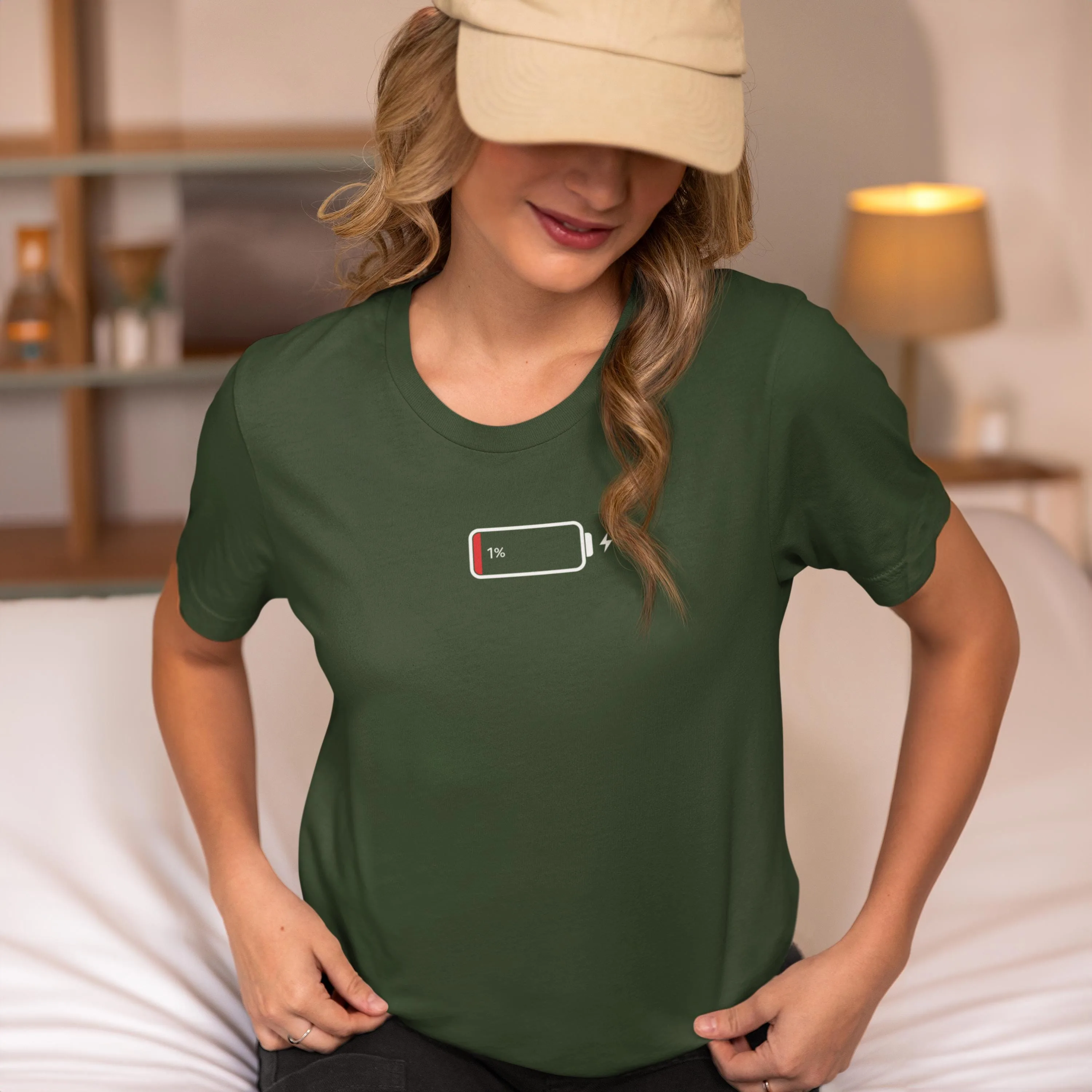
This is the part most people don't picture. Every single piece in our tee collection goes through this individual production cycle. There's no batch-printing of a hundred low-battery tees waiting for someone to order them. There's just yours, getting made.
Days 5–7 - pack and label
The finished piece gets folded (or bubble-wrapped, for mugs), tagged, packaged, and labeled with your shipping address. A tracking number gets generated and sent to Etsy, which forwards it to you. This is when most people get the "your order has shipped" notification.
Days 7–14 - in transit
The shipping carrier (usually USPS for domestic, varies for international) takes it from there. Continental US delivery is typically 3–7 business days after handoff. International is more variable - 7–21 days depending on the destination and customs.
The two-week trade-off in detail
So what do you get for the wait?
You get a fresh piece. The shirt wasn't pulled from a warehouse where it sat in a plastic bag for eight months. The mug wasn't part of a 5,000-unit batch from a factory you'll never see. The ink is freshly cured, the fabric hasn't been folded in storage for a year, the print is as sharp as it was the moment it came off the press.
You get something that wouldn't otherwise exist. This is the part that most people don't think about. If nobody had ordered this specific shirt in this specific color in this specific size, it wouldn't have been made. There's no inventory glut, no markdown-bin clearance later, no leftover stock sitting in a landfill. The piece exists because you wanted it to.
You're not subsidizing waste. Fast fashion's price advantage comes from the same warehouse-and-batch model that produces enormous amounts of unsold inventory. Made-to-order doesn't have unsold inventory by definition. Less waste in the system, less in the cost structure.
You get quality inspection at a sane scale. When a single piece goes through production at a time, the inspection step is meaningful. When a thousand pieces a minute fly through a contract-manufacturing line, "inspection" is statistical sampling at best. The defect rate on our orders is well under 1% specifically because someone actually looks at each piece.
When fast shipping is actually a red flag
A graphic tee that arrives on your doorstep in 48 hours from order to delivery is almost never made-to-order. That timeline is impossible without pre-made stock sitting in a warehouse. There's nothing wrong with that supply chain in principle - it's just a different model with different trade-offs.
If the shop in question is selling "custom" or "personalized" or "limited-edition" designs at the same lead time as Prime, that's the red flag. Custom takes time. The faster the turnaround on something supposedly bespoke, the more likely it's actually pre-printed inventory with a customer name slapped on at the warehouse.
What you can do about it
If you're shopping for a specific date - a birthday, a holiday, a graduation - order with a buffer. Two weeks is the typical lead time for most of our products, so ordering at least 14 days before the date covers production and standard shipping. For peak seasons (mid-November through late December especially), pad to three weeks if you can.
If you're shopping for "whenever" - a treat for yourself, a not-time-sensitive gift - the two-week wait is invisible. The piece arrives, you've forgotten you ordered it, and now there's a new shirt or mug in your day.
Either way, the longer-than-Prime timeline is the trade-off, and it's the one we've decided is worth it. Less waste, fresher product, real inspection, designs that wouldn't exist without specific demand for them.
If you want the longer version of how the studio actually operates, the about page covers it. If you want to skip the meta and just see what's in the catalog, everything is here.